Calgary Solar Production Trends

Below is actual production data over the past few years that I pulled from my inverters. It shows clear patterns, but always some variations. You can really see the years we had a lot of smoke or lots of snow. Note this is in kWh.

Below is a slightly different view from Spot Power which shows the imports vs. exports to the grid to decide when to switch from winter to summer solar rates.

Solar Results for 2024

Like my 2022 results post and my 2023 results I wanted to provide an update on how our solar did in 2024.

Overall we had a net contribution of $2720 and the results were a little worse than 2023 but slightly better than 2023. We had production of 12,000 kwh in 2024; of which we sold 7600 kwh back to the grid. This was about 1500 kwh less than 2023, I assume due to the Tesla being set to charge during the day so we don’t have to pay distribution and transmission charges.

For all our financial calculations we use the real solar club rate for what we produce in the summer, but only price our internally used power at the “grid” rate which we use 8.3 cents per kwh. Like in 2023 we use 6 cents for our variable Distribution and Transmission cost, so internally consumed kwh are always 14.3 cents. This is important as our results are not inflated using a higher export solar club rate, although that is our opportunity cost.

Our payback period remains at 9 years with an additional 5 years to go. This is the most common financial metric I get asked. I thought this was optimistic, but we have remained at 9 years payback throughout which is great.

Snow Solar Performance Update

Was chatting with a buddy that just installed his system. Not surprisingly his experience was the same as mine, no production after snow. He was also told of the NAIT study and how snow wouldn’t be a problem…

Thought I would past another picture, this time with a bit of cold snap after a brief warming period.

Solar Carbon Credits

Something the folks at Solar Clubs told me about was the ability to sell your carbon offsets. I did look into this a bit, and when I checked into it it was going to pay like $100 a year, which was not enough for me to sell my carbon credits as I expected them to increase in value over time.

However, a new provider is in Alberta and came out with a much more reasonable plan. If you go to solaroffset.ca they can provide a reasonable plan, and I signed up. In my case with a 12kW system I should make ~$500 a year from my carbon credits.

The program is for 10 years, and Solar Offset takes 30% of the sale of the credits in the real carbon market. Thus, if the value of the credits rise you get more money, and of course if they fall you get less. From my perspective that is a reasonable proposal.

The other part is if I sell the house before the 10 years is up the new owners aren’t obligated to continue using the program. This wasn’t the case in some of the other programs as they were forward selling the credits so couldn’t lose production. That’s just too messy for a home owner like me.

The only downside is by selling my credits I am not really carbon neutral in my power any more. I can feel good, but it does diminish the impact for sure. Given most of these commercial systems would do the same thing, I figure I can live with it.

Solar Panel Performance in Snow

One of the things I was told when I bought my panels was that snow didn’t make a major impact on production. I have heard this story from a number of other folks that have purchased solar panels as well. This position is always based on this NAIT study from 2018 https://techlifetoday.ca/articles/2018/solar-shines-in-dead-of-winter-even-in-edmonton

The approach appears scientific, and I’m sure it was, however, the conclusions simply aren’t what you’ll actually experience. I can say with two winters experience you will get absolutely ZERO production with snow on a normal 4/12 pitch roof. I have experienced wet snow, dry fluffy snow and blizzards. In ALL cases my production was effectively zero until it warmed up enough to melt the snow off the panels. Anyone who tells you differently is not telling you the truth.

Below is a picture of a recent snow followed by warming. You can exactly when the snow came, and when the Chinook came that melted it off.

In this example with a poorly written finger label, we hear a loud “whump” as the panels shed their snow as they warmed up. The time of the production jump – right after the snow slid off.

So what can you do? Nothing – but don’t be disappointed that you won’t be getting any production for as long as you have snow on your panels.

Sorry NAIT, your study doesn’t stand up to the real world conditions the rest of us live in.

Solar Production App

With the solar panels clearly working I was then able to get my very cool solar production app installed and working. It told me lots of things I wanted to know and was very exciting to see.

I was able to get the web version to share so here is my current results.

powered by Advanced iFrame

powered by Advanced iFrame

My electric meter going backwards

After install we were allowed to turn on our solar panels, and low and behold my meter started going backwards!

My electric meter

Something I didn’t know at the time, and wish someone had told me, was that these old style meters are way more lucrative with solar power. This is because you get credit for all the power you are putting back – including distribution charges. This is a material impact as per my financial post.

Clearly the panels were working, which was very exciting!

Unfortunately i was in a rush to get my net-meter installed, which in hindsight I should have just let the very slow wheels of Enmax do on their own sweet time…

Solar Installation

Getting an install date

Like many things during COVID Solar YYC was having various supply problems. The original panels (Longi 360) weren’t available, so we ended up getting Longi 375 watt panels. They were slightly larger so the system would be a little bigger which was nice. Total system size moved to 12 kilowatt.

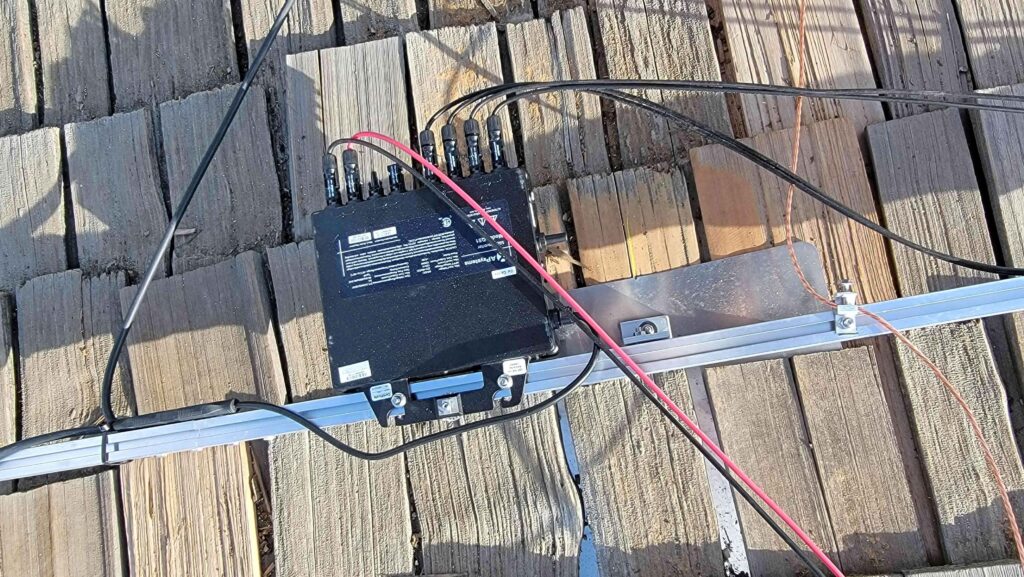
We were able to keep our micro-inverters which were AP System QS1 & YC600.

Once the panels were available we then ran into various other shortages including the shake flashing. But finally the big day came in the early fall. About 3 months behind plan, and production would be lost for the peak summer months, but I figured it wasn’t going to be any better next year so might as well go ahead.

Installation

The crew arrived, was nice to talk to and began getting things organized. The only significant hitch was with the new panels my roof vents were in the way for some panels and four had to be put on the North side of the roof. Not ideal but I figured it was better than not having them.

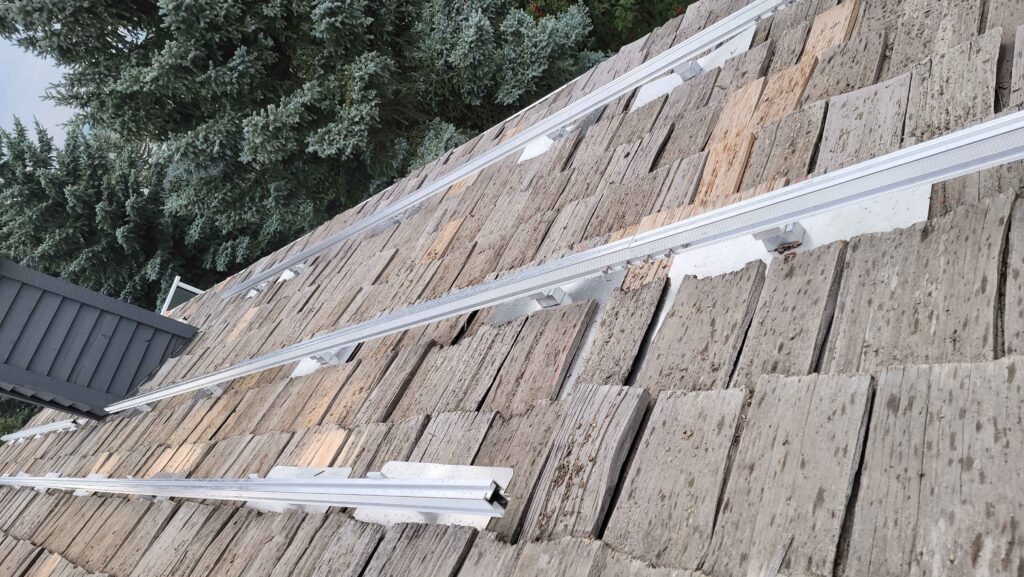
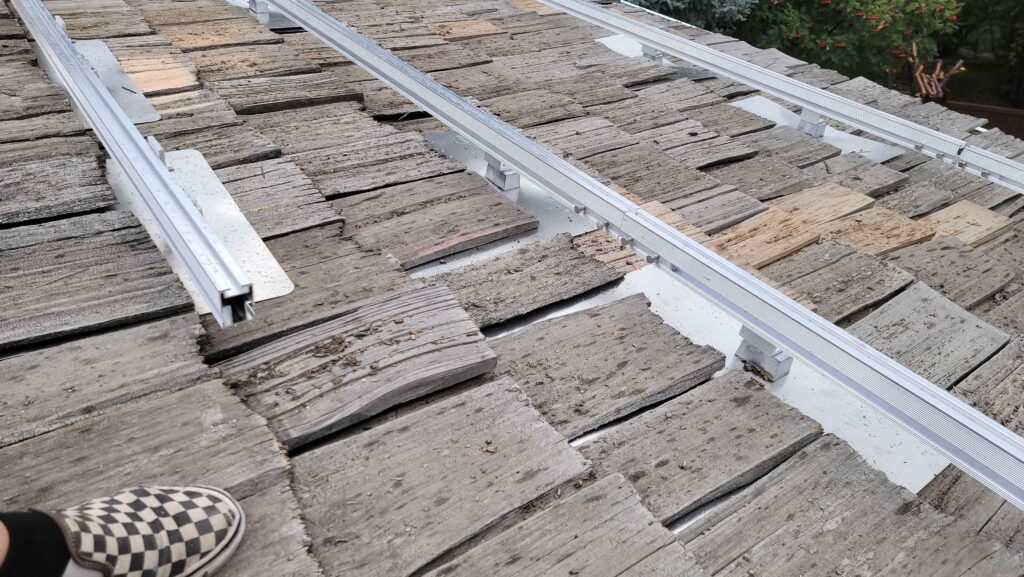
The first day was getting most of the rails and flashing in place and levelled.

Rails in place
Rails in place with flashing

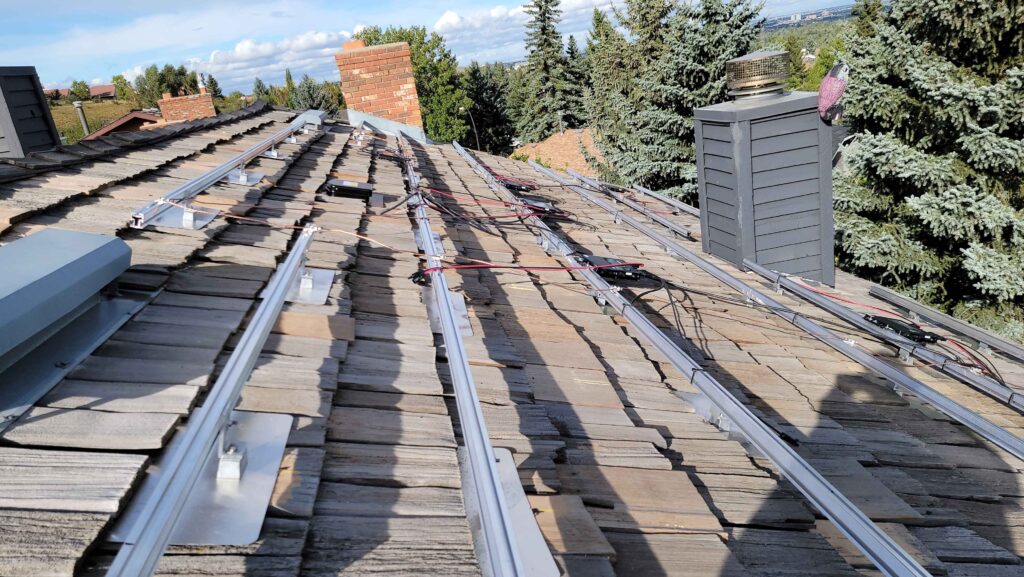
Next day was getting the rest of the rails and the micro-inverters starting to get laid out.

Micro-inverters getting laid out on rails
Micro-inverter mounted

The next day was the big day – the panels went on!

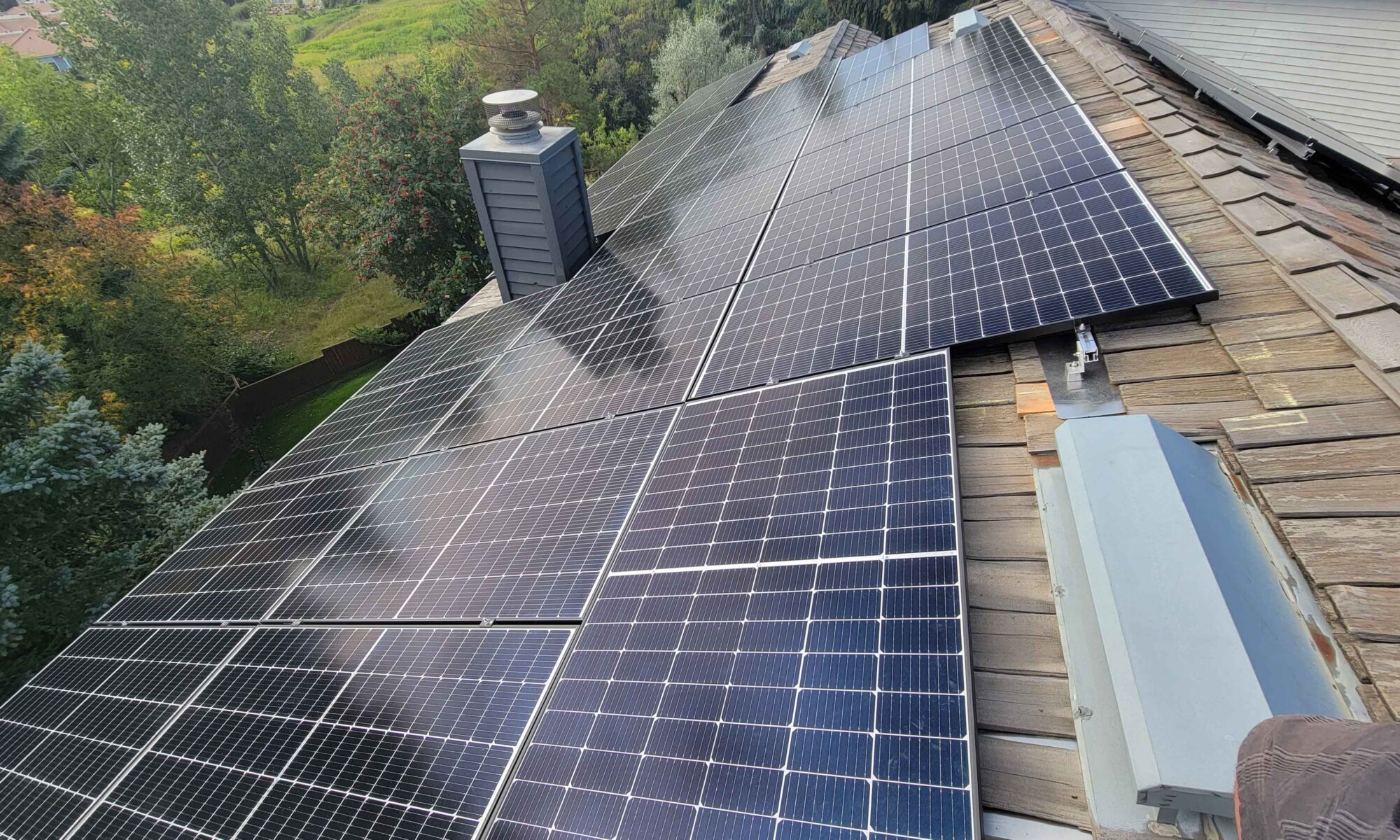
Panels installed
North panels

Solar Financial Analysis

Government Programs

Living in Calgary, Alberta there were no municipal or provincial government programs available when I was looking into installing solar. Luckily for me the Government of Canada decided to launch a Greener Homes Grant through NRCAN. It is always nice of the government to bribe me with my own tax dollars!

Wit this grant you can get up to $5000 of home retrofits and the cost of a home energy assessment up to $600. You have to get an initial home assessment done (before work begins) and then after the work is completed.

For interest there a provincial program for municipalities here.

Getting the grant

Nothing dealing with the government is easy. I had a hard time finding a solar energy assessor, and while I received a tracking number after applying that was it.

Eventually I did get an assessment which I will provide in another post, however, never heard boo from NRCAN. I did call the 1-800 number which was especially useless. I said I applied about 5 months ago and haven’t heard anything. The answer was they couldn’t see the status of my application. I asked why the site says most people hear in weeks not months; the response was we can’t see anything. I mean why have a 1-800 number if the agents have no visibility to anything?

After nearly 6 months my application was finally approved, after the solar already installed. Now I just have to get a final energy audit.

Financial Analysis

I love Excel. It can do all sorts of great things, like estimate how long a solar system will take to pay off.

I had a couple of payback estimates from the folks that originally gave me quotes. Both seemed to say payback was about 9 – 13 years. This was primarily due to Solar Clubs and bi-directional metering. Essentially you can get a higher rate while you are producing more solar than you are consuming. The rate was about 26 cents a kWh so material. The bigger the system the quicker the payback if you are over 100%.

My big model error

While the solar rate is great, I made a fundamental error in my model. When calculating the value of my power I included the variable distribution costs. So in my system I assumed a total power cost of 13 cents, of which 7 was variable energy costs and 6 was distribution. This is true for power I consume, HOWEVER, it is not true for power I push to the system. I only get credit for the production (7 cents in this example). This was materially less than I had modelled, so my payback will be longer than expected.

I should note that both of the companies that provided financial models made this same assumption so were certainly showing an accelerated payback.

Distribution Cost Avoidance

Given how much the monthly fixed and variable distribution costs are (generally significantly more than the actual energy costs) I wanted to avoid them as much as possible. The way we have been doing that after discovering the model issue above is to use our high energy devices in the daytime. For example we used to run our dishwasher at night, but it would make far more sense to run it during the day when we had solar production. The difference is about 6 cents a kWh of variable distribution charges – nearly as valuable as the actual power!
Solar Panels for my House

Background

My wife and I have been looking at Solar for years, but I could never make it make financial sense. I had looked into both solar water heating with vacuum tubes and solar photoelectric. This past spring we decided to take another look.

As you may know Calgary is very sunny generally, and a large portion of our power generation is coal, so it certainly would have positive environmental impact. You can see an approximate solar energy production estimate at several sites like PVWatts from the US Government.

Through some research it seemed like it might now make at least some financial sense (i.e. an eventual payback).

System quotes

With some hope I reached out to about 4 solar installation companies in Calgary. A couple replied with a very high level quote using a satellite image of my house. Their quotes probably were good enough for my initial needs.

Two companies did come and visit my house to take a look and give me a more detailed quote with some explanations. Prices were fairly similar within about 15% or so.

The big difference I found between the companies was their ability to answer questions and explain why they recommended what they did. The one company was clearly a salesperson with no solar background and really couldn’t tell me why they were commending what they were.

Vendor Selection

We ended up selecting SolarYYC. They were very helpful in explaining things to us, and came back and did an electrical assessment to provide a firm quote.

One of the biggest reasons I chose SolarYYC was they use micro-inverters. The other providers seemed to a single larger inverter.

Solar Micro-inverters

Solar Micro-inverters as per Wikipedia “is a plug-and-play device used in photovoltaics, that converts direct current (DC) generated by a single solar module to alternating current (AC). Microinverters contrast with conventional string and central solar inverters, in which a single inverter is connected to multiple solar panels. The output from several microinverters can be combined and often fed to the electrical grid.

Microinverters have several advantages over conventional inverters. The main advantage is that they electrically isolate the panels from one another, so small amounts of shading, debris or snow lines on any one solar module, or even a complete module failure, do not disproportionately reduce the output of the entire array. Each microinverter harvests optimum power by performing maximum power point tracking (MPPT) for its connected module.[1] Simplicity in system design, lower amperage wires, simplified stock management, and added safety are other factors introduced with the microinverter solution.”

The primary disadvantage is micro-inverters cost more initially. My south roof has a large tree on the north east side, and a chimney in the middle I knew I would get a fair amount of shading. Given this micro-inverters became quite important to me, so this was a great benefit of the SolarYYC proposal.